29th December 2025
Author: xq
I’m researching on how good current LLMs are in programming, so i’m doing some vibecoding.
The results are exciting and creepy.
I had three round-trips with ChatGPT 5.2 Thinking.
First prompt had hello-gui.zig, graphics.zig (containing CommandQueue), and ashet.abi attached, and looked like this:
i’ve attached a small hello-world like program for graphical applications, and the file containing the CommandQueue structure. I’ve also attached the kernel api definition containing basically all necessary enums. Implement a “2048” style game for Ashet OS. Do not assume much about the code structure, and if something is unclear, ask me about it before you write any code.
It had some questions which I answered:
- mono-8 is a good font with 8 pixels height and 5 pixels width pet char.
- Use a std.Random.DefaultPrng
- Use an in-game overlay
- arrow keys, wasd, numpad, and R for restart
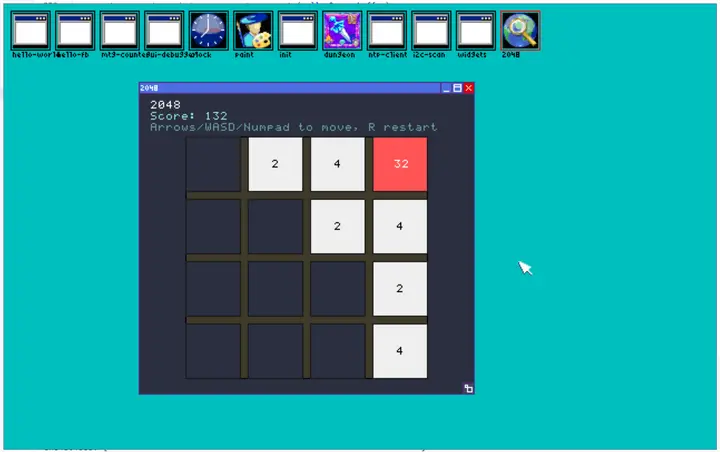
The model basically yielded a playable version of 2028, with only the mistake of not using @divFloor and having misunderstood that abi.clock.monotonic() can’t fail.
I then prompted again, trying to stretch my goals:
okay, i had to some fixes in Color.from_html, and adjust the default window size to 256x256.
I’ve attached the working, compiling version here. changes i want to have:
- tiny move animation with 4 or 8 frames
- allow playing after winning
- remove the “2048” title in the window (we have window decorations!)
- use mono-6 font for the tutorial text line
It yielded the version you can see here:
I am thoroughly impressed.
This means that Ashet OS soon™ ships another useful application, which is 2048.
23rd December 2025
Author: xq
I’ve got “slightly” derailed while updating HyperDoc to Zig 0.15.2, and I’ve started working on HyperDoc 2.0:
hdoc(version="2.0" , lang="en");

title{HyperDoc 2.0}

toc;

h1{Paragraphs}

p { This is a \em "simple" paragraph containing text. }

p(id="foo") {
  This is a paragraph with an attribute "\mono{id}" with the value "\mono{foo}".
}

h1{Special Paragraphs}

warning { Nobody expects the Spanish Inquisition! }

h1{Verbatim and Preformatted Text}

pre(syntax="c"):
| #include <stdio.h>
| int main(int argc, char const * argv[]) {
|   printf("Hello, World!\n");
|   return 0;
| }

h1{Lists}

ul {
  li { p { Apples } }
  li { p { Bananas } }
  li { p { Cucumbers } }
}
A full example can be found on GitHub
16th December 2025
Author: xq
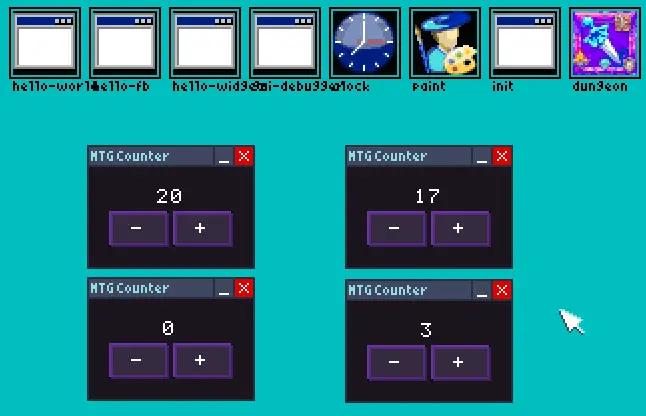
Ashet OS now has its first production-ready application!
A Magic The Gathering Life Counter!
I guess it’s as simple as an application can be, and it’s actually useful to some people, so we can definitely say that’s close to production-grade software.
16th December 2025
Author: xq
I’m working on the widget subsystem of the kernel and it starts to work already!
This makes me really happy, as it means we can soon start making really cool applications.
What’s unusual about the Ashet OS GUI:
The code implementing the widget logic is neither in the kernel nor in the application but in a special application called the “widget server” which provides the rendering, data and logic that is widget specific via special IPC routines.
This means that applications can be expanded and widgets can be implemented in any programming language, even dynamically.
It even allows changing the behavior of widgets fully at runtime, as long as you keep some basic properties steady (hit test visible, focusable, …)
This also means that you can replace and modify all applications by exchanging your desired widget server.
It… also allows some incredibly stupid things, and it has meme potential.
Consider the “global radio”, a radio button that, assuming network is present, can only be enabled on a single machine in a single radio button instance.
If you click it, it goes off for everybody else.
You can find a full usage demo for widgets at GitHub
1st December 2025
Author: xq
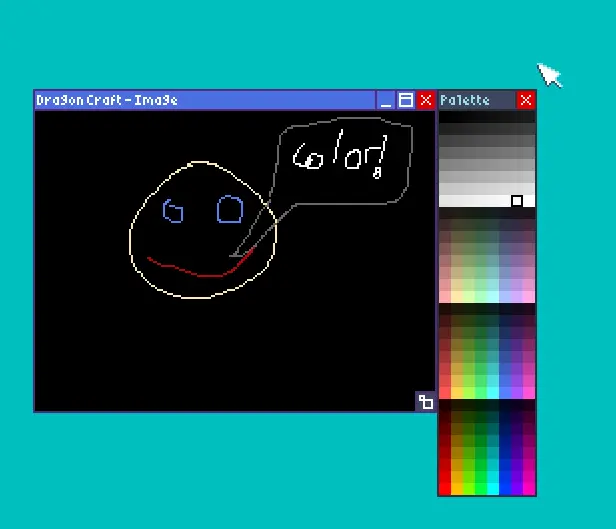
I’ve finally improved the Paint application to support color selection and palette showcasing:
26th November 2025
Author: xq
I’ve just applied to the NGI Zero Commons Fund with the Home Computer, with the proposal to make the system replicable (so everyone could replicate it).
Wish me luck!
25th November 2025
Author: xq
Two new changes on the Meta Front:
https://github.com/Ashet-Technologies/Home-Computer/blob/main/LICENSE
The hardware designs are now licenced under CERN-OHL-P-2.0 license and we have a social media preview
9th November 2025
Author: xq
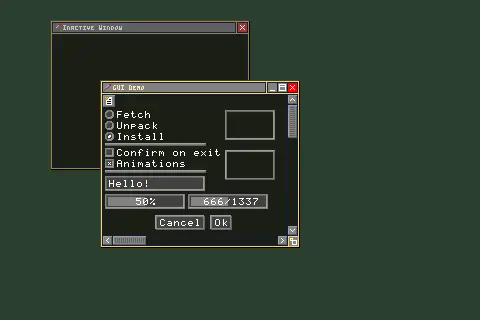
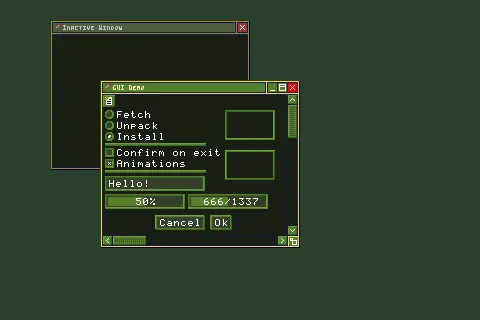
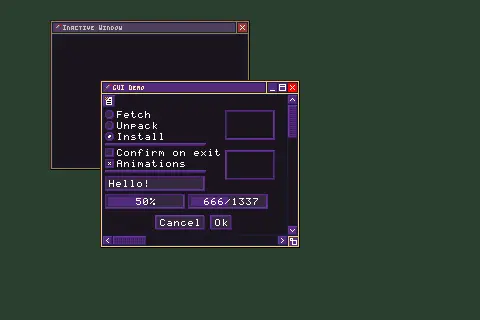
The previous image was hand-pixeled. These three are programmatically generated, so i have the base render routines working for this style.
While implementing the renderer, I figured that now that we’re using HSL based color scheme, we’ve gained the ability to trivially reskin the UI into 8 colors, 4 levels of color intensity and 6 different brightness levels.
5th November 2025
Author: xq
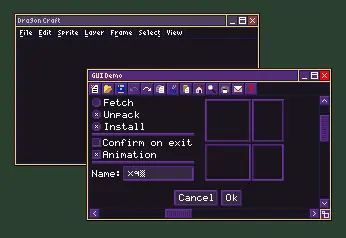
I’m finally working to bring the new GUI design to live, using the new color scheme and using the new palette!
Here’s the current draft drawn in Aseprite:
I’m not 100% confident on the purple intensity, but i’m pretty confident about the scale, shape and shade of things.
Also I’m super proud of my pretty legible 8x8 icons.
25th October 2025
Author: xq
Greetings from the Zigtoberfest!
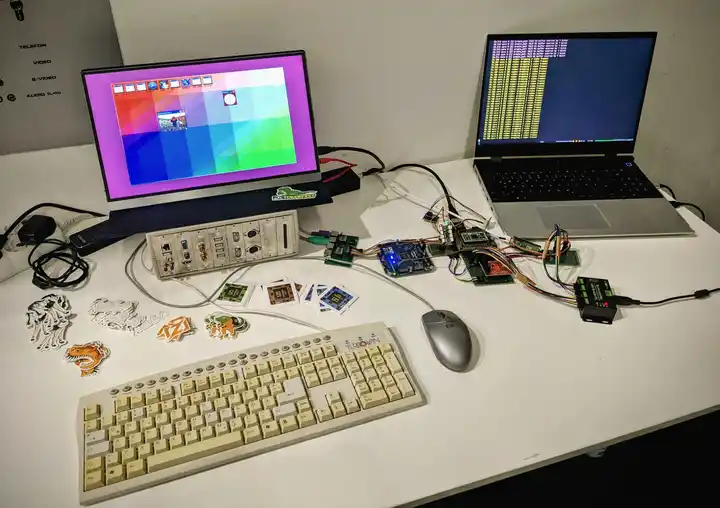
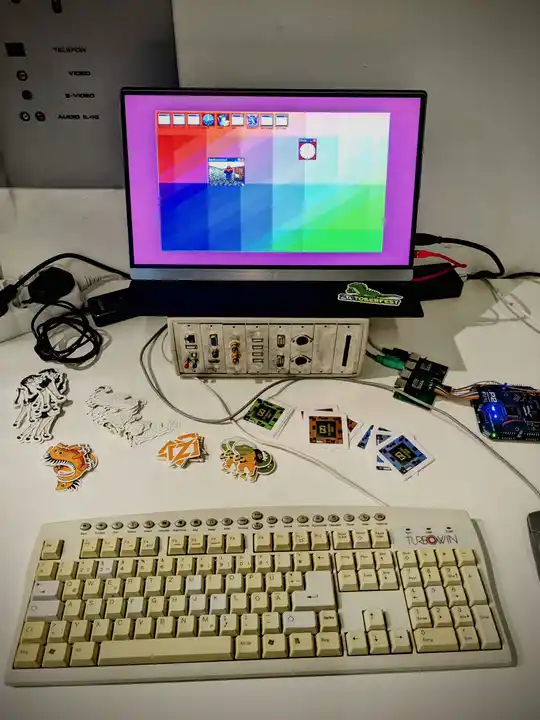
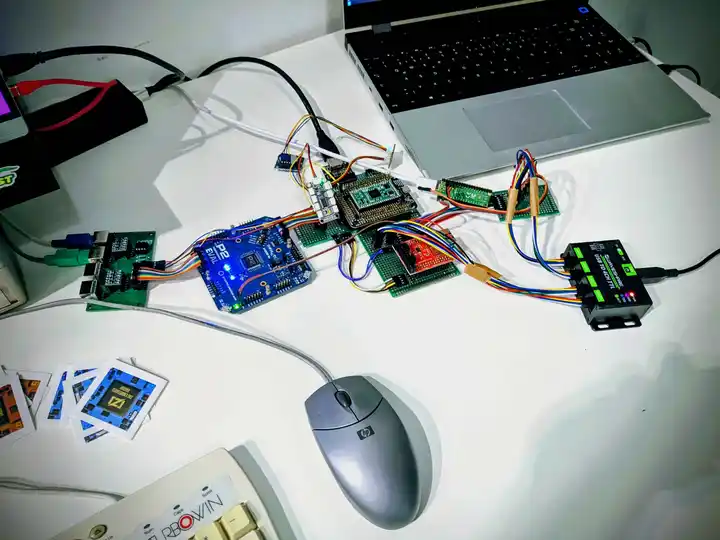
I visited the Zigtoberfest and did a tiny exhibition showcasing the Ashet Home Computer to the visitors:
The general reception was really great. People were impressed by the state of the project and are looking forward for future updates.
24th October 2025
Author: xq
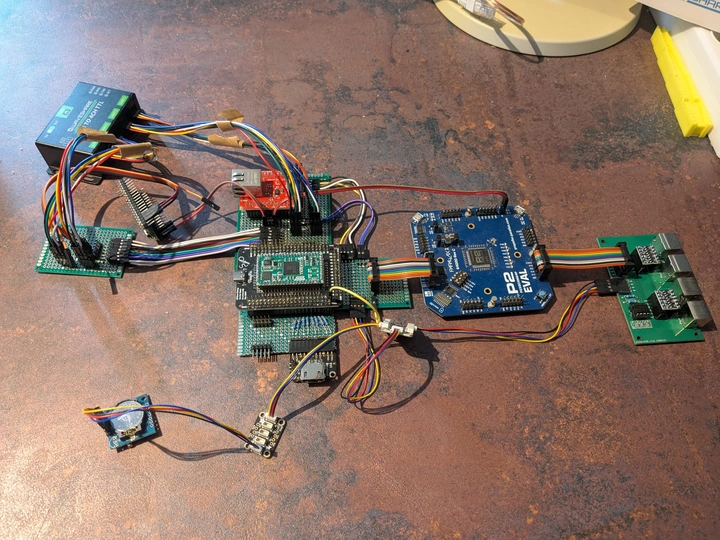
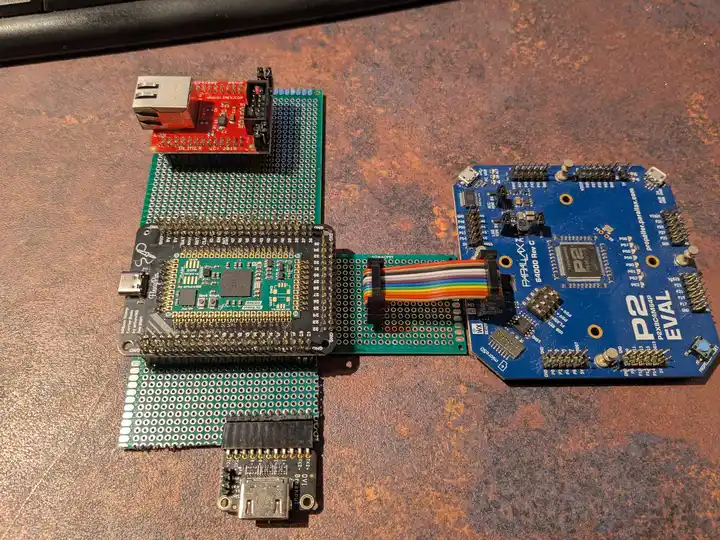
After one week of intense work, I’ve managed to fully rebuild what I had before, but now much more structured and stable:
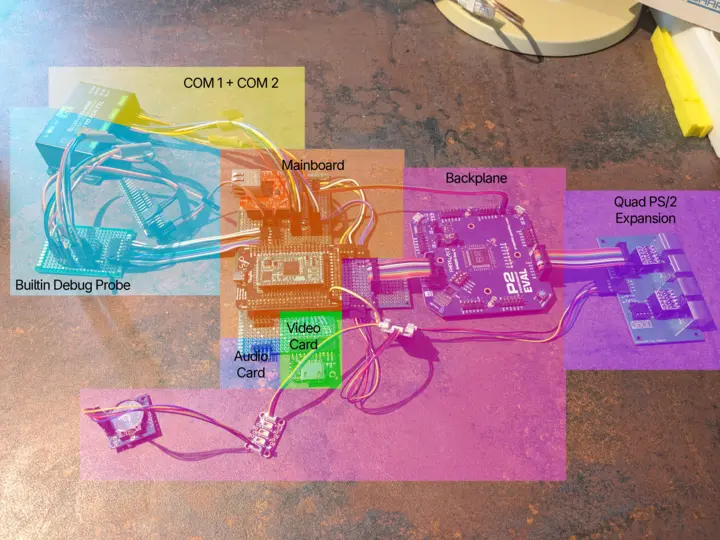
This is the whole electronics setup of the home computer right now. It contains most components of the final design except for power management, USB and the sound expansion.
USB and sound are the next parts of HW development, but I want to focus on some OS design details I’ve found during implementing all of the prototype stuff.
Also there’s no userland serial port API yet.
20th October 2025
Author: xq
5 days later, we’re in the “booting to desktop again” phase of the rebuild:
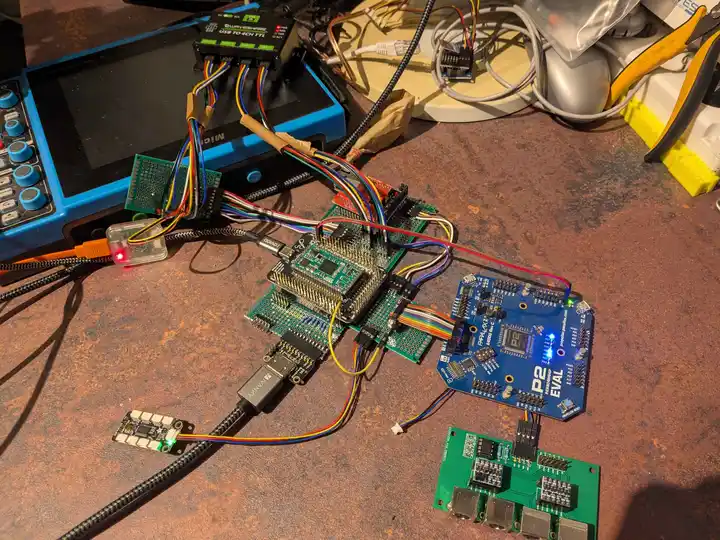
Most soldering work is done, and a good amount of stuff also works again:
- 🆕 Dedicated debug outputs per cpu core
- 🆕 COM1 and COM2 serial ports
- 🆕 “User Port” (4 GPIOs)
- DVI video output
- Southbridge link to Propeller 2 board
- I²C subnets
What’s yet missing:
- Driver for ENC424J600 (should be fairly easy compared to current one, i’ve already got reset implemented)
- Audio subsystem (i routed the pins to a pinheader, but didn’t find the right I2S modules yet
- ETM trace port (routed to pins, but no testing yet)
- Dedicated debug probe: Right now, i use the Raspberry Pi Debug Probe and a 4× UART-USB adapter to emulate what i really want. For now, I’ll use a Raspberry Pi Pico for this prototype to emulate the debug probe embedded on the mainboard.
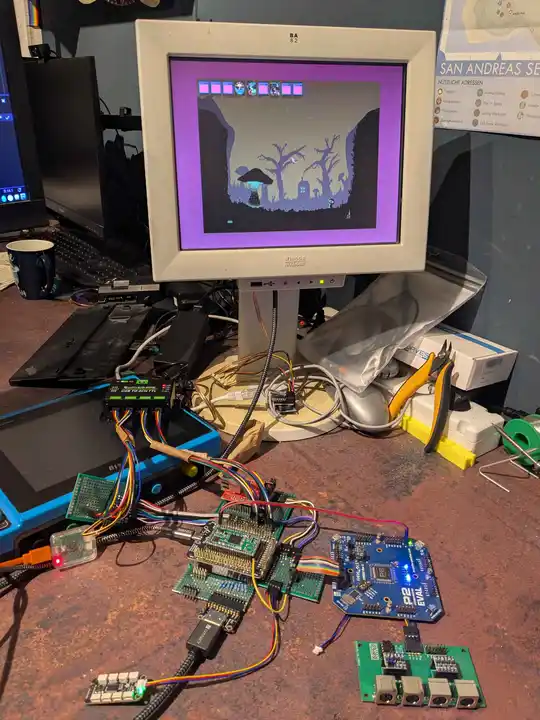
This makes me really happy right now because it looks like I can showcase a standalone system at Zigtoberfest 2025 in Munich this weekend!
There’s now even a cool photo on the Zigtoberfest page that shows the Ashet Home Computer being displayed next to the speakers area.
15th October 2025
Author: xq
I have dismantled the cable clutter prototype as it was now way, way too cluttered for me to keep maintaining it.
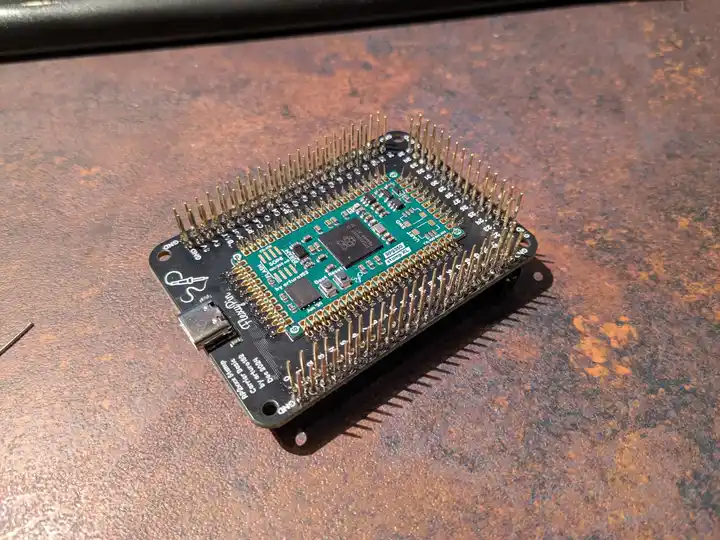
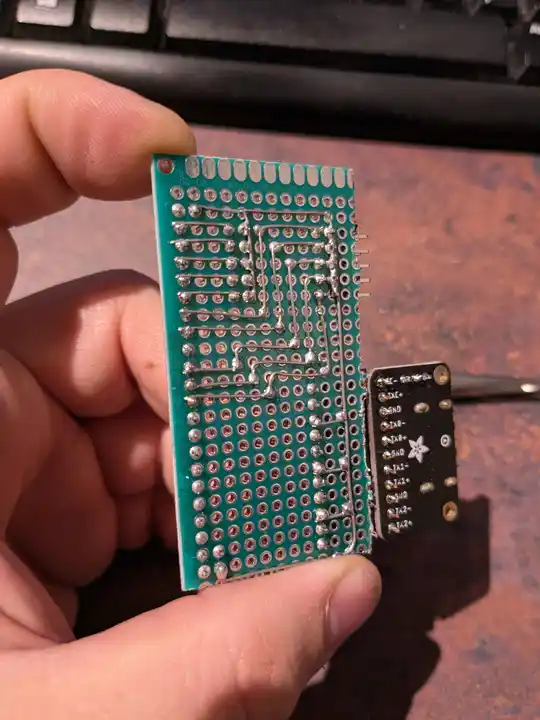
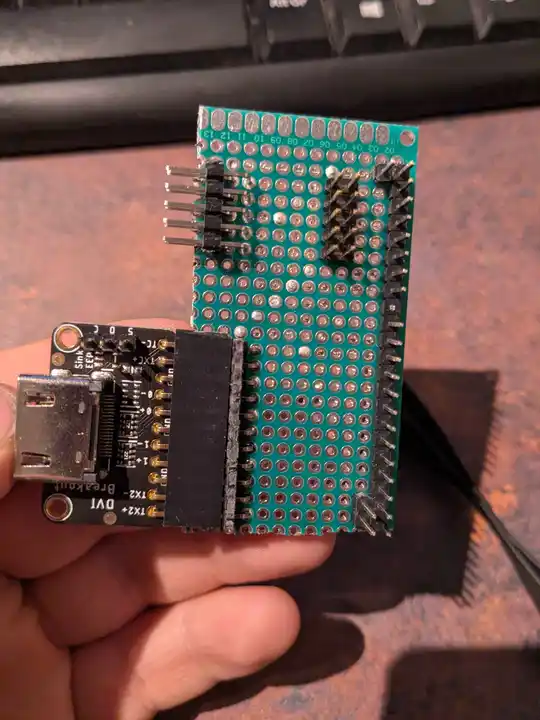
Right now, I don’t have a working prototype anymore, but i’ve already started assembling the new second prototype using another RP2350 carrier board, and some adapter PCBs
The goal with this new prototype is:
- Figure out the final pinout
- Make the device more portable (physically transportable)
- Make it more feature complete